
Federal Prison Release Paths
The Federal Bureau of Prisons holds sentenced federal prisoners and maintains a locator with many historical results. A person leaving a BOP institution may enter the community, begin federal supervised release, move to another jurisdiction, or complete a federal custody event while another lawful hold remains. The locator's affirmative “Released” status and date are useful evidence of the BOP event, but they do not describe every later custody or supervision issue.
Federal custody is not one database. The U.S. Marshals Service controls many people from court-ordered pretrial detention through acquittal or delivery to BOP. It may use local, state, or contract beds. Someone held for federal court can therefore be absent from sentenced-prison locator data. George W. Hill, PA DOC, ICE, and BOP each answer only their own custody question.
| Federal result | What it supports | What it does not prove |
|---|---|---|
| “Released” with date | BOP recorded release on that date | No later custody or supervision |
| Current BOP institution | Current sentenced federal confinement | County or state case status |
| “Not in BOP custody” | No current BOP custody match | Release from all authorities |
| No result | Search produced no match | Freedom from custody |
Confirm a Federal Prison Release
Search the official BOP Inmate Locator by register number when available. Number searches can also use DCDC, FBI, or INS identifiers supported by the form. For a name search, enter the exact name and use race, age, and sex filters only as identity aids. Compare the result with the federal case rather than relying on a name alone.
- Record the exact locator result, BOP register number, location or status, release date if supplied, and retrieval time.
- Match the person to the federal criminal docket and sentence. The court record explains the judicial event but not always the exact door-exit time.
- If pretrial custody or transport is possible, identify the USMS district or actual holding facility instead of assuming BOP coverage.
- If another state, local, military, or immigration custodian may be involved, search or contact that authority separately.
The Delaware County release search gives the county and PA DOC routes for a person whose case was not federal or whose federal custody ended in a handoff.
Federal Prison Release Records
BOP's locator generally reaches records from 1982 forward. Its historical release date can answer a basic question, but a documentary request may be needed for the underlying federal record. Start from the official locator notes and BOP record instructions. Use the register number, full identity details, institution if known, and approximate release period so the agency can identify an existing record.
A federal court docket can show the sentence, judgment, later orders, and supervised release term. Supervised release is a court-ordered period in the community after imprisonment, not continued BOP confinement. A docket does not necessarily certify the physical time of release, so preserve the BOP record as the custody source and the court record as the legal source.
U.S. Marshals Service, Eastern District of Pennsylvania601 Market Street, Room 2110
Philadelphia, PA
Phone: 215-597-7272
No public historic USMS person locator was identified. Contacting the Marshals is appropriate only when federal pretrial or transport custody is genuinely at issue. Ask for the correct public route and avoid requesting private movement or security details.
BOP Release Search Fields
The BOP form supports identity checks through either a number or name search. A register number is far stronger than a common name. Historical results may state “Released” and a date. That is an agency custody fact, not an explanation of why release occurred or whether a later jurisdiction acted.
| Input or output | Use | Limit |
|---|---|---|
| BOP register number | Best direct identity match | Must match the person |
| DCDC/FBI/INS number | Alternative supported identifier | Not every person has each number |
| Name and filters | Find candidates | Names and ages can collide |
| Release date | Confirms BOP's recorded event | Does not explain later custody |
Keep the result's exact language. Do not turn “not in custody” into “released,” and do not turn a historical release date into proof that all supervision ended. If the federal docket and BOP record disagree, record both retrieval dates and seek agency clarification.
USMS Custody Near Delaware County
The U.S. Marshals Service may hold a federal defendant from the court's detention order until acquittal, release by court action, or delivery to BOP after conviction. Placement can occur outside a federal prison. A local or contract facility may therefore possess day-to-day custody records while USMS remains the responsible federal authority.
When a person never appears in BOP despite a federal case, inspect the Eastern District of Pennsylvania docket and identify counsel or the named holding facility. A court release order is legal authority, but the responsible custodian must still process it and resolve other holds. This is the federal counterpart to the difference between a docket entry and physical release at a county jail.
- BOP custody
- Federal prison custody administered by the Bureau of Prisons.
- USMS custody
- Federal court-related detention and transport administered by the Marshals Service.
- Supervised release
- Community supervision imposed by the federal court after imprisonment.
- Transfer
- A change of custodian or facility while confinement continues.
View Federal Release Results
The official BOP locator is the federal search source for a privacy-safe current or historical check.
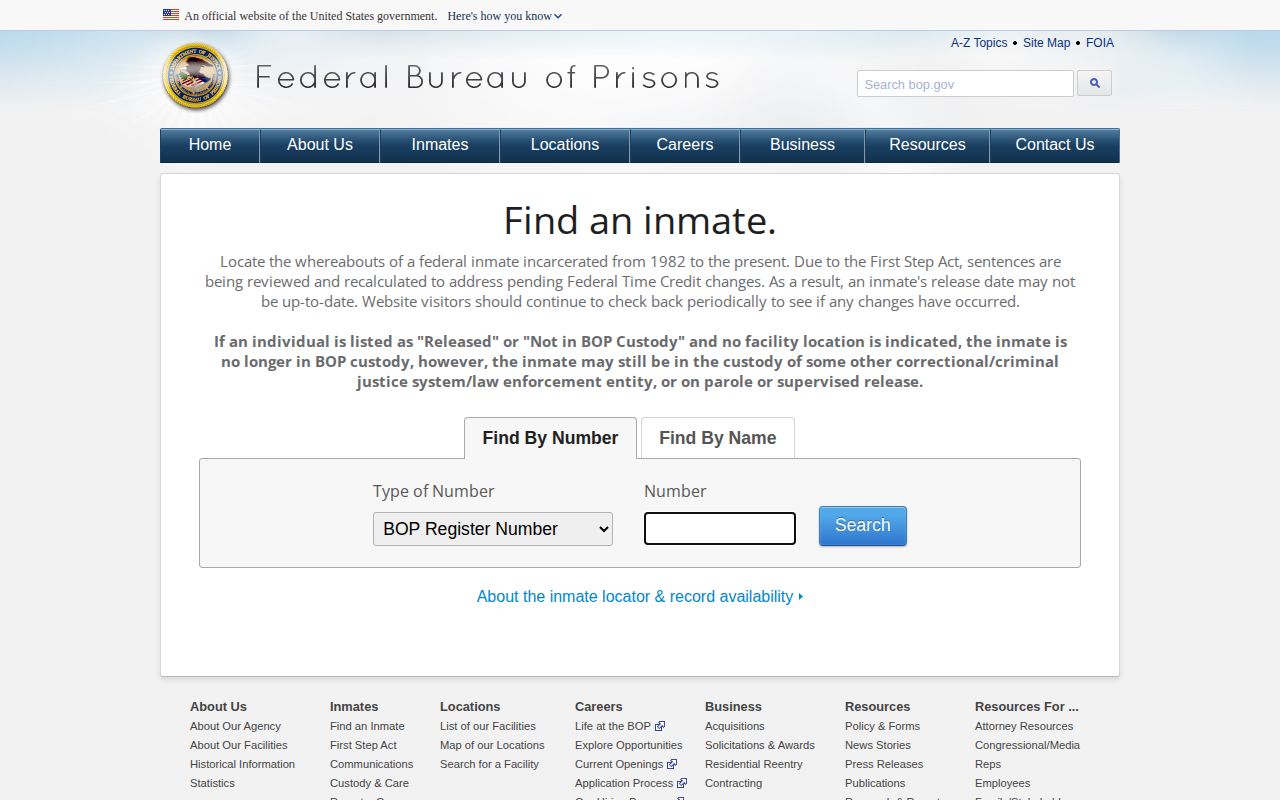
The image shows the correct federal interface. A live query, exact identifier match, and federal docket review are still required.
Historical Federal Release Records
BOP describes the locator as covering federal prisoners generally from 1982 forward. That starting point matters for an older Delaware County-area federal case. A missing pre-1982 episode can reflect the locator's historical scope rather than an identity or custody conclusion. Use the federal court archive and an agency records route when the event predates available locator coverage.
For covered years, preserve the name as displayed, register number, status, release date, and retrieval date. A historical “Released” record is stronger than the phrase “Not in BOP custody” because it affirms an event rather than merely describing current BOP control. Still, the result should not be expanded beyond BOP. Federal supervised release, a state case, or later immigration custody can exist after the BOP date.
When an exact register number is unavailable, reconcile name, age, sex, federal district, sentence date, and docket. Avoid assigning a record on a common name alone. If two candidates remain possible, the correct conclusion is that no reliable match has been established.
Federal Court Release Records
The Eastern District of Pennsylvania docket is the durable legal source for many federal cases connected to Delaware County. It may show a detention order, judgment, sentence, modification, or supervised release action. Those entries explain authority and sequence. They do not replace the custodian's record of the physical release or transfer.
Federal supervised release should not be confused with parole. It is a court-imposed term served after imprisonment under federal supervision. A BOP release date can mark the prison event while the court's supervision term continues. Report both facts when they are relevant, using each source's terminology.
Federal Release and Other Custody
A BOP release may lead to the community, but another authority can act. State warrants, local cases, military custody, or immigration action each require a separate official check. If the record identifies a receiving agency, report a transfer. Do not call the event an unrestricted community release.
For immigration custody, the ICE Online Detainee Locator uses an A-number and country of birth or exact biographical details. It is not part of BOP. For a Pennsylvania case, use PA DOC. For George W. Hill, use VINELink, UJS, and county Central Records. One negative result cannot answer all four systems.
Note: The most reliable federal conclusion states the BOP event precisely and names any unresolved custody question separately.
Official Federal Custody Scope
BOP's locator record notes explain the historical coverage and the limits of federal prison data. The U.S. Marshals Service custody overview explains the separate pretrial and transport role. Reading both prevents a BOP gap from being mistaken for release. The court docket then supplies the judicial context for the named case.